Thursday, August 12, 2010

Grief, mourning and bereavement

A medical student asked me the differences between grief, mourning and bereavement. I said I didn't know and I'll get back to him with the answer before his psychiatry posting ends.

After doing some reading (lazily), this is my conclusion:

  • Grief: reaction (emotional response, unable to face work etc)
  • Bereavement: period (period after death happens)
  • Mourning : rituals (wearing dark clothes, tahlil etc)

Am I right?

-------------------------------------------------------------------------------------------------

The terms grief, bereavement, and mourning are often used in place of each other, but they have different meanings.

Grief is the normal process of reacting to the loss. Grief reactions may be felt in response to physical losses (for example, a death) or in response to symbolic or social losses (for example, divorce or loss of a job). Each type of loss means the person has had something taken away. As a family goes through a cancer illness, many losses are experienced, and each triggers its own grief reaction. Grief may be experienced as a mental, physical, social, or emotional reaction. Mental reactions can include anger, guilt, anxiety, sadness, and despair. Physical reactions can include sleeping problems, changes inappetite, physical problems, or illness. Social reactions can include feelings about taking care of others in the family, seeing family or friends, or returning to work. As with bereavement, grief processes depend on the relationship with the person who died, the situation surrounding the death, and the person’s attachment to the person who died. Grief may be described as the presence of physical problems, constant thoughts of the person who died, guilt, hostility, and a change in the way one normally acts.

Bereavement is the period after a loss during which grief is experienced and mourning occurs. The time spent in a period of bereavement depends on how attached the person was to the person who died, and how much time was spent anticipating the loss.

Mourning is the process by which people adapt to a loss. Mourning is also influenced by cultural customs, rituals, and society’s rules for coping with loss.

Grief work includes the processes that a mourner needs to complete before resuming daily life. These processes include separating from the person who died, readjusting to a world without him or her, and forming new relationships. To separate from the person who died, a person must find another way to redirect the emotional energy that was given to the loved one. This does not mean the person was not loved or should be forgotten, but that the mourner needs to turn to others for emotional satisfaction. The mourner’s roles, identity, and skills may need to change to readjust to living in a world without the person who died. The mourner must give other people or activities the emotional energy that was once given to the person who died in order to redirect emotional energy.

People who are grieving often feel extremely tired because the process of grieving usually requires physical and emotional energy. The grief they are feeling is not just for the person who died, but also for the unfulfilled wishes and plans for the relationship with the person. Death often reminds people of past losses or separations. Mourning may be described as having the following 3 phases:

  • The urge to bring back the person who died.
  • Disorganization and sadness.
  • Reorganization.


Wednesday, August 11, 2010

Monday, April 19, 2010

Id, ego, and superego


The Structural Model of Mind

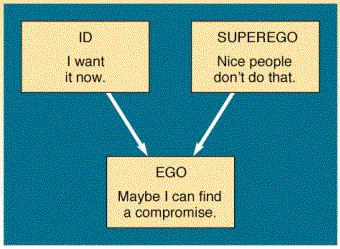
Freud came to see personality as having three aspects, which work together to produce all of our complex behaviours: the Id, the Ego and the Superego. All 3 components need to be well-balanced in order to have good amount of psychological energy available and to have reasonable mental health.

THE ID (“It”)

“this is what I want. What I really really want.”

  • Equates to child
  • the irrational and emotional part of the mind.
  • The Id is the primitive mind (At birth a baby’s mind is all Id - want want want).
  • It contains all the basic needs and feelings.
  • It is the source for libido (psychic energy).
  • It has only one rule: the “pleasure principle”: “I want it and I want it all now”.
  • Id too strong = bound up in self-gratification and uncaring to others

THE EGO: (“I”)

“I am, I can and I will.”

  • equates to "Adult".
  • the rational part of the mind.
  • develops out of growing awareness that you can’t always get what you want.
  • The Ego realises the need for compromise and negotiates between the Id and the Superego.
  • The Ego relates to the real world and operates via the “reality principle”: Ego's job is to get the Id's pleasures but to be reasonable and bear the long-term consequences in mind. The Ego denies both instant gratification and pious delaying of gratification.
  • The term ego-strength is the term used to refer to how well the ego copes with these conflicting forces. To undertake its work of planning, thinking and controlling the Id, the Ego uses some of the Id's libidinal energy
  • Ego too strong = extremely rational and efficient, but cold, boring and distant

THE SUPEREGO (“Over-I”)

“I should, I ought and I must.”

  • the moral part of the mind.
  • the last part of the mind to develop
  • The Superego becomes an embodiment of parental and societal values.
  • It stores and enforces rules.
  • It constantly strives for perfection, even though this perfection ideal may be quite far from reality or possibility.
  • Its power to enforce rules comes from its ability to create anxiety.
  • The Superego has two subsystems: Ego Ideal and Conscience.
  • The Ego Ideal provides rules for good behaviour, and standards of excellence towards which the Ego must strive. The Ego ideal is basically what the child’s parents approve of or value.
  • The Conscience is the rules about what constitutes bad behaviour. The Conscience is basically all those things that the child feels mum or dad will disapprove of or punish.
  • Superego too strong = feels guilty all the time, may even have an insufferably saintly personality


Monday, April 12, 2010

Friday, March 12, 2010

BIPOLAR SPECTRUM DISORDER

The great German neuropsychiatrist, Emil Kraepelin, described what he termed manic-depressive insanity at the end of the nineteenth century. He conceptualized a continuum that included today's DSM-IV subtypes, mixed and rapid cycling states, many of the soft bipolar variations and also episodic depressions. This view prevailed until the 1960's, at which time the creators of the first DSM edition ( DSM-I ) proposed a differentiation between major depression and manic-depressive illness. In later DSM editions, this evolved to the unipolar - bipolar dichotomy. In the 1970's Fieve and Dunner discriminated bipolar I from bipolar II disorder, a seminal event in the evolution of the soft bipolar spectrum. Gerald Klerman was the first to postulate a further subtyping of bipolar disorders in 1981. Klerman's Classification of Primary Bipolar Subtypes is summarized as follows:

Klerman's Primary Bipolar Subtypes

(Psychiatric Annals #17: January 1987)

Bipolar I: Mania and depression
Bipolar II: Hypomania and depression
Bipolar III: Cyclothymic disorder
Bipolar IV: Hypomania or mania precipitated by antidepressant drugs
Bipolar V: Depressed patients with a family history of bipolar illness
Bipolar VI: Mania without depression [unipolar mania]

http://www.psycom.net/depression.central.lieber.html